The mad honey plant: Rhododendron species

Resident Medical Reviewer · Family Medicine Physician and Integrative Wellness Specialist
Quick answer: The mad honey plant: Rhododendron species
Mad honey is produced when bees forage on single-origin Rhododendron species — primarily R. ponticum (Turkey, Caucasus), R. luteum (Turkey), R. arboreum (Nepal, Himalayan India), R. campanulatum (high Himalaya), and R. grande (Bhutan, Sikkim). These species grow at altitude in the Himalayas, Pontic Mountains, and Caucasus, producing nectar concentrated enough in grayanotoxin that bees foraging heavily on them yield ly active honey. Not all rhododendrons are toxic; many ornamental hybrids produce harmless honey.
The plant at the heart of the category
Mad honey exists because Rhododendron exists. Without single-origin Rhododendron species foraged by bees at a density high enough to dominate the resulting honey, no mad honey is possible. Understanding the botany is understanding the upstream input to the entire category.
The genus Rhododendron
Rhododendron is a large genus of about 1,000 species in the Ericaceae (heath) family. It's distributed across Asia, Europe, and North America, with the highest species diversity in the eastern Himalaya — eastern Nepal, Sikkim, Bhutan, Arunachal Pradesh, and Yunnan (China). Most species are evergreen shrubs or small trees; some are deciduous (the genus Azalea is technically a subset of Rhododendron).
Of those 1,000 species, only a small fraction produce grayanotoxin in commercially-relevant concentrations. The species responsible for commercial mad honey production are concentrated in a handful of temperate-alpine regions where they grow in dense monoculture-adjacent stands.
The primary mad-honey species
Rhododendron ponticum (Pontic rhododendron)
The primary source of Turkish deli bal. Native to the Pontic coast of Turkey, the Caucasus, and — as an invasive introduction — parts of western Europe (Ireland, UK, Iberia). Produces purple flowers in late spring. Nectar is rich in grayanotoxin III, with smaller amounts of I and II. Grows to 8 meters. The species most widely documented in European cases of "mad honey" poisoning because it's the only significant single-origin rhododendron in Europe.
Rhododendron luteum (yellow Pontic azalea)
Co-occurs with R. ponticum in Turkey and the Caucasus. Deciduous, yellow flowers. Also produces grayanotoxin-rich nectar, contributing to Turkish deli bal in varying proportions.
Rhododendron arboreum (tree rhododendron)
National flower of Nepal. The primary source of Nepalese mad honey. Grows as a tree to 12 meters with vivid crimson flowers ("Lali Gurans" in Nepali). Native across the Himalayan arc from Kashmir to Yunnan. The subspecies cinnamomeum and campbelliae dominate at different altitudes. Nectar is rich in grayanotoxin I — the most potent isoform.
Rhododendron campanulatum
High-altitude Himalayan species (3,000–4,500 m). Pale pink to lavender flowers. Contributes to peak-altitude honey batches where bee foraging pushes into the higher elevational belt.
Rhododendron grande
Large-leaved species native to Bhutan, Sikkim, and eastern Nepal. Creamy-white to pale-yellow flowers. Primary contributor to Bhutanese mad honey. Slightly different grayanotoxin isoform distribution than R. arboreum, giving Bhutanese product a distinctive profile.
Rhododendron falconeri
Another eastern Himalayan large-leaved species. White-to-pink flowers. Co-dominates with R. grande in Bhutan.
Other single-origin species (minor)
- Rhododendron maximum (eastern US, Appalachian) — produces mildly toxic honey; not commercialized.
- Rhododendron catawbiense (Appalachian) — similar.
- Rhododendron occidentale (western US) — mild grayanotoxin content.
- Rhododendron japonicum (Japan) — historical Japanese "toxic honey" reports.
- Rhododendron macrophyllum (Pacific Northwest) — mild content.
None of these is commercially harvested for mad honey; they are noted primarily for occasional accidental exposures where wild honey from areas where these species dominate has produced mild grayanotoxin symptoms.
Non-toxic rhododendrons
Most ornamental rhododendron hybrids bred for garden use are not significantly grayanotoxin-productive. Centuries of breeding for flower color, compact growth, and climate tolerance have selected away from high-grayanotoxin lineages. Honey from bees foraging on hybrid garden rhododendrons typically tests below clinically significant thresholds.
However: the plant material — leaves, stems, flowers — of many garden rhododendrons still contains grayanotoxin. Poisonings have occurred in pets (dogs, cats, horses) that chewed on garden rhododendron. The nectar concentration is lower than the leaf concentration; bees diluting nectar through forage mixing produces diluted honey.
Geographic distribution — the mad-honey belt
Commercial mad honey comes from three main regions of concentrated grayanotoxin-Rhododendron coverage:
- Himalayan arc: From Kashmir east through Nepal, Sikkim, Bhutan, to Arunachal Pradesh and into Yunnan. R. arboreum, R. campanulatum, R. grande, R. falconeri dominate.
- Pontic coast (Turkey) and Caucasus: R. ponticum and R. luteum dominate; the "deli bal belt."
- Scattered high-altitude European (Iberia, Scotland) invasive R. ponticum: occasional historical reports of wild mad-honey exposure but no commercial production.
Bloom timing — why it matters
Mad honey is only produced when Rhododendron nectar dominates bee foraging. That requires bloom to be happening in volume. Bloom timing varies:
- Turkish R. ponticum: late May to early July.
- Nepalese R. arboreum: March (lower elevation) to May (higher).
- High-altitude Himalayan species: late April to early June.
Honey harvested outside bloom windows is lower-potency because bees forage a mixed flora. This is why Nepalese producers distinguish spring vs. autumn harvests — autumn product is weaker because Rhododendron is past bloom and bees have foraged more diverse flora.
Altitudinal bloom wave
One of the continent's notable botanical phenomena: the Himalayan Rhododendron bloom wave. Bloom begins in late March at 1,500 meters and moves upward through the spring, reaching 4,000+ meters in late May. Bees (managed hives in Turkey, wild Apis laboriosa in Nepal) follow the wave. This creates an informal "harvest calendar" that shapes commercial production.
Conservation
Commercial and traditional pressure on wild Rhododendron stands raises conservation concerns. Key issues:
- Overharvesting in Nepal: as global demand has grown, unauthorized outside harvesters have begun raiding cliffs, reducing hive-replenishment capacity.
- Climate change: Himalayan bloom timing is shifting earlier and upslope, displacing harvest infrastructure.
- Invasive R. ponticum in Europe: outside its native Pontic range, R. ponticum is a notorious invasive displacing native woodland flora. UK and Ireland spend significant money removing it.
- Bhutanese species protection: Bhutan's environmental controls restrict commercial harvesting to protect native Rhododendron forests.
Gardening caveat
If you grow rhododendrons and also keep bees, there's a theoretical mad-honey risk. In practice, garden-hybrid rhododendrons produce low-grayanotoxin nectar, and most suburban bee-keeping setups include diverse flora that dilutes any single nectar source. The exception: if you have a large stand of R. ponticum (common invasive in parts of the UK and Ireland) and hives foraging primarily on it during bloom, your honey may contain measurable grayanotoxin. UK food-safety guidance addresses this scenario. The practical risk is low but non-zero.
Identifying Rhododendron
If you want to identify Rhododendron in the field:
- Evergreen or deciduous shrubs/small trees (species-dependent).
- Leathery, oval-to-lanceolate leaves, usually dark green.
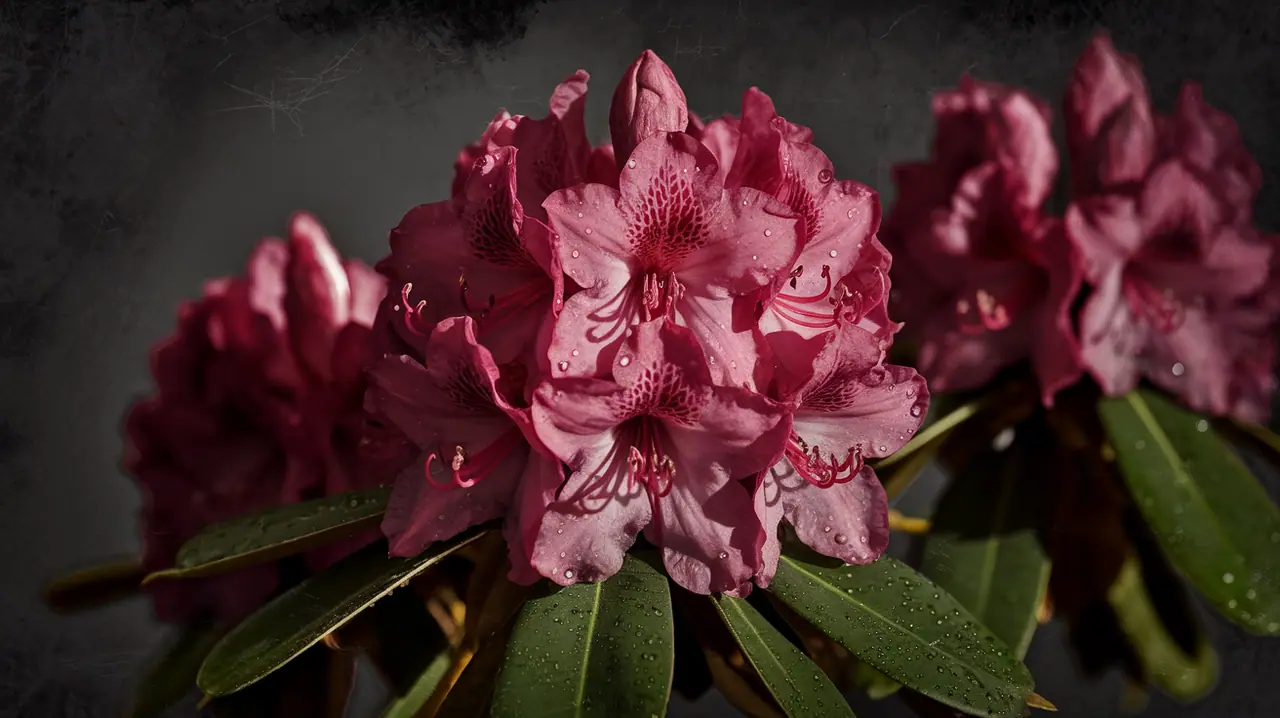
- Bell- or tubular-shaped flowers in terminal clusters ("trusses"), typically 5-petaled.
- Flowers range from white through yellow, pink, red, purple depending on species.
- Seeds in small dry capsules.
Rhododendron in traditional medicine
Multiple traditional medicine systems — Ayurveda, Tibetan, Nepalese folk — use Rhododendron leaves, flowers, or preparations for various indications: pain, digestive complaints, respiratory conditions. These uses carry significant grayanotoxin-exposure risk that is separate from honey consumption. Modern evidence for most traditional medicinal uses is thin, and the toxicity risk is higher than for honey consumption because the leaves are more concentrated than the nectar.
Bottom line
Rhododendron is the upstream input to the entire mad honey category. Five species produce the commercial product: ponticum and luteum (Turkey), arboreum and campanulatum (Nepal), grande (Bhutan). Their single-origin nectar, foraged at density by bees, becomes the honey. Understanding the botanical source helps you understand the product variability, the geographic concentration, the seasonal constraints, and the conservation dynamics.